What do 'Adagio' and 'Allegro' mean? Classical music terms Performance dynamics Tempo Music terms
What do 'Adagio' and 'Allegro' mean? Classical music terms Performance dynamics Tempo Music terms

Most classical music is written in Latin or Italian. It is useful to know the classical music terms that are often used in concerts.
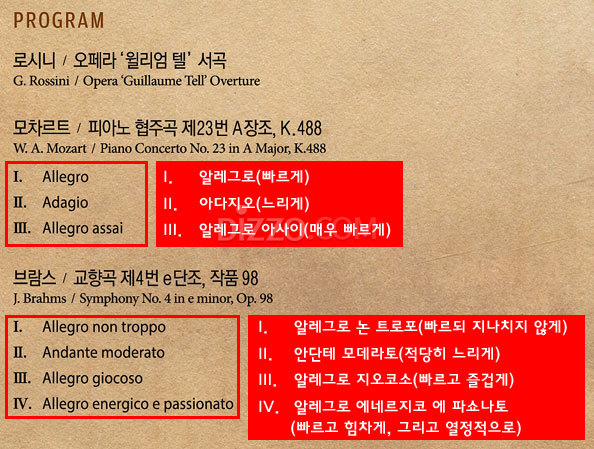
In classical music, the speed (speed) of the progression of a piece is called tempo. Tempo refers to the speed of a piece of music, and there are various terms that refer to tempo in Italian, and most of them are also in Italian. Adagio (slow), Allegro (fast), Moderato (moderately fast) are terms that refer to tempo. Other names that indicate tempo are as follows:
■ Main tempo terms (in order of tempo)
▷ Lento: Slow (indicates that the entire piece should be played slowly)
▷ Andante: Slow (the speed of a slow walk)
▷ Moderato: Normal tempo. Between andante and allegro.
▷ Allegro: Fast
▷ Presto: Fast
■ Other tempo terms
▷ Lentissimo: Very slow
▷ Adagissimo: Very slow
▷ Adagietto: Slightly faster than adagio
▷ Allegrissimo: Very fast
▷ Prestissimo: Very fast
■ Tempo terms that appear in the middle of a performance
▷ rall. (rallentando/라럴탄도): Gradually slower
▷ A Tempo: Back to the original tempo (back to the tempo just before changing)
▷ Poco: Little by little, little by little
▷ adagio non molto: A little slower, not too slow
▷ energico: Powerfully
▷ Passionate: Passionately
▷ giocoso: Playfully, joyfully
▷ Assai: Very, sufficiently
■ Other terms used with tempo
▷ Tempo Primo: Back to the initial tempo
▷ accel. (accelerando/아슐레란도): Gradually faster
▷ rit. / ritard. (Ritardando/Ritardando): Gradually slower
▷ Vivacissimo: Very fast
▷ Sostenuto: With a restrained tempo
▷ Larghetto: Slightly faster than Largo
▷ Larghissimo: Very slowly
▷ Grave: Solemnly slow
▷ Vivace: Lively fast (indicates that the entire piece is to be played quickly)
▷ Allegretto: Slightly faster
▷ Andantino: Slightly faster than Andante
▷ Adagio: Calmly slow
▷ Largo: Slowly, slowly
---------------
'Adagio(아다지오)', 'Allegro(알레그로)'는 어떤 의미일까? 클래식 음악 용어 연주 셈여림표 템포 음악 용어
클래식 음악은 대부분 라틴어나 이탈리아어로 쓰여진 부분이 많다. 많이 쓰이는 클래식 음악 용어는 알아두면 연주회에서 유용하다.
클래식 음악에서 악곡 진행의 빠르기(속도)는 템포(tempo)라고 한다. 템포는 곡의 빠르기를 가리키는 이탈리아어로 템포를 지칭하는 다양한 용어들이 있으며, 역시 대부분 이탈리아어로 되어 있다. Adagio(아다지오: 느리게), Allegro(알레그로: 빠르게), Moderato(모데라토: 보통 빠르기) 등이 템포를 일컫는 말이다. 그 밖의 템포를 알려주는 명칭은 다음과 같다.
■ 주요 템포 용어(템포 순서대로)
▷ Lento(렌토): 느리게(악곡 전체를 느리게 연주하라는 표시)
▷ Andante(안단테): 느리게 (천천히 걷는 걸음걸이의 빠르기)
▷ Moderato(모데라토): 보통 빠르기. 안단테와 알레그로 중간 빠르기.
▷ Allegro(알레그로): 빠르게
▷ Presto(프레스토): 빠르게
■ 그 외의 템포 용어
▷ Lentissimo(렌티시모): 매우 느리게
▷ Adagissimo(아다지시모): 매우 느리게
▷ Adagietto(아다지에토): 아다지오보다 조금 빠르게
▷ Allegrissimo(알레그리시모): 매우 빠르게
▷ Prestissimo(프레스티시모): 매우 빠르게
■ 연주 중간에 나오는 템포 용어
▷ rall. (rallentando/랄렐탄도): 점점 느리게
▷ A Tempo(아 템포): 본디 빠르기로(변화하기 직전의 빠르기로)
▷ Poco(포코): 조금, 조금씩
▷ adagio non molto(아다지오 논 몰토): 조금 느리게, 너무 느리지 않게
▷ energico(에네르지코): 힘차게
▷ Passionate(파쇼나토): 열정적으로
▷ giocoso(지오코소): 익살스럽게, 즐겁게
▷ Assai(아사이): 매우, 충분히
■ 템포와 함께 쓰이는 기타 용어
▷ Tempo Primo(템포 프리모): 최초의 빠르기로
▷ accel. (accelerando/아첼레란도): 점점 빠르게
▷ rit. / ritard. (Ritardando/리타르단도): 점점 느리게
▷ Vivacissimo(비바치시모): 매우 빠르게
▷ Sostenuto(소스테누토): 억제하는듯한 빠르기로
▷ Larghetto(라르게토): 라르고보다 조금 빠르게
▷ Larghissimo(라르기시모): 매우 천천히
▷ Grave(그라베): 장중하게 느리게
▷ Vivace(비바체): 발랄하게 빠르게(악곡 전체를 빠르게 연주하라는 표시)
▷ Allegretto(알레그레토): 조금 빠르게
▷ Andantino(안단티노): 안단테보다 조금 빠르게
▷ Adagio(아다지오): 침착하게 느리게
▷ Largo(라르고): 천천히, 느리게


.jpg)


댓글